Straight Course or Turning Track? Reading the Shape of a Racecourse
Learn how a straight course or turning track shapes the route and your view, so you can read a racecourse map and choose a useful vantage point.
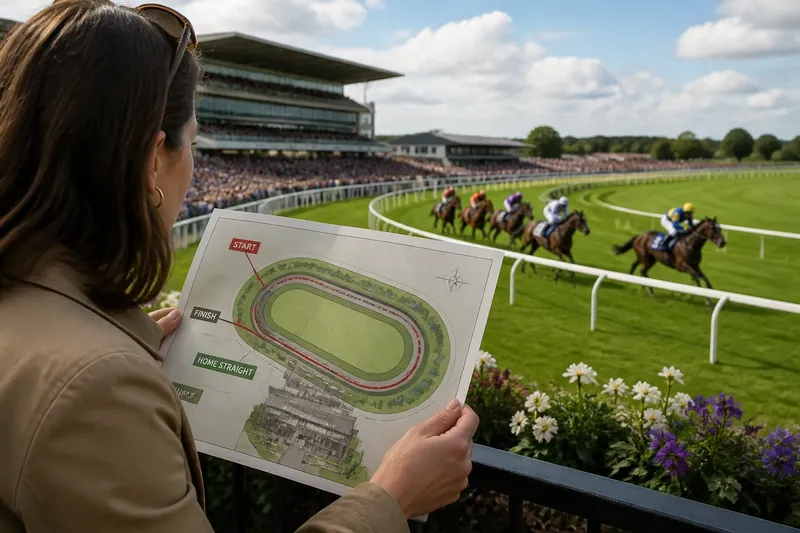
A racecourse map can show whether a field runs down a straight or rounds a bend before the finish. To read a straight course or turning track, trace the route for the specific race rather than relying on the venue’s general label.
A straight course gives the field a direct route
On a straight course, the marked route runs toward the finish without taking the field around a bend. The ground may rise or dip, and the course may sit at an angle to the grandstand; “straight” describes the route, not the shape of the view.
From some positions, spectators can follow the runners along much of the course. From others, the field may approach, recede, or cross the line of sight. The grandstand, rails, and direction of travel all affect what is visible.
Find the start and finish on the map, then orient yourself to the direction of travel. That makes it easier to tell whether the runners will move toward you or across your view, and where the finish lies relative to the public areas.
A turning track carries the field around bends
A turning track includes one or more bends between the start and finish. Maps may show an oval, a circuit with bends of different shapes, or a route that uses only part of a larger course.
The curve changes the route the field follows, but it does not dictate how the race unfolds. Runners may bunch, spread, or change order around a bend; these are possibilities, not automatic effects of the layout.
Locate the finish and home straight, then trace the route backward to the start. This shows where the field changes direction and whether the start sits on a straight section or near a bend.
The map and viewing angle tell different parts of the story
A map establishes the route, but your position determines how clearly you see it. From a low rail-side view, perspective can make nearby runners look more prominent and compress the apparent gaps among those farther away. From a higher stand, the course shape may be easier to follow, though buildings or distance can still obstruct parts of the field.
On a bend, runners occupy a curve rather than one line across the view. Some may be hidden behind others, and the inside and outside of the turn can look quite different from the stands. A broadcast camera may show another angle, so use the map to understand the route when the field moves out of sight.
Say you arrive at an unfamiliar course and the runners disappear behind a stand after the start. You check the race map, trace the route, and see that it follows a bend before reaching the home straight. The likely explanation is that the field is following the mapped course out of view, not taking an unexpected route; you can look toward the straight for its next visible section.
Check the race-specific start and finish
A venue can offer more than one route or starting point, and a race may use only part of the overall layout. The course map for the particular race is therefore more useful than a general diagram of the venue.
Check where the start sits in relation to the first bend, and where the home straight begins. A straight course may include a rise or dip, while a turning course may have a straight section before or after a bend. Those details describe the route without changing its basic category.
Racecourse websites and printed visitor information are practical places to look for maps. Compare the marked route with the grandstand and public enclosures to see where the field may pass and where the view may be blocked.
Use the same checks for either course shape
When comparing a straight course with a turning track, separate what the map establishes from what it cannot tell you. It shows the route and the positions of the start and finish; it does not predict how runners will be placed or how the race will develop.
- Check the map title and the route marked for the race. If it identifies the specific course configuration, use it; if it is only a general venue diagram, look for the race-specific map before judging the route.
- Check the start and finish markers. If both are clearly shown, trace the route between them; if either is missing, consult the racecourse’s visitor information rather than guessing.
- Check whether the marked line includes a bend. If it does, note where the turn sits; if it does not, treat the route as straight while still checking for rises, dips, or a separate approach section.
- Check where the home straight begins. If the route turns onto it, identify the turn as a useful viewing point; if the straight begins without a bend, look for a clear view of the approach to the finish instead.
- Check the map against the grandstand and public enclosures. If a building or rail blocks part of the route, choose a public viewpoint with a clearer line of sight; if the route appears open from your position, use it to follow the field’s progress.
- Check whether the venue map shows multiple starts or course configurations. If it does, match the race to its marked route; if it does not, avoid assuming that every race at the venue follows the same path.
Which details should you look for on a racecourse map?
How can I tell if a race uses a straight course?
Trace the route marked for that race from start to finish and check whether it takes the field around a bend. If the map shows more than one configuration, use the line for the individual race rather than the venue’s overall outline.
What is the home straight?
The home straight is the final straight section leading toward the finish. On a turning route, it follows the bend that brings the field around toward the finishing line.
Does a bend always make a race harder to watch?
No. A bend may provide a clear view of the field turning, or it may be partly obscured by buildings, distance, or the viewing angle. Check the map against the public areas before choosing where to watch.
Can a racecourse have both straight and turning routes?
Some venues show different starts or course configurations on their maps. Check the route marked for the race you plan to watch instead of assuming that every event uses the same layout.
Choose a viewpoint that suits the route
For a straight course or turning track, follow the race-specific line from start to finish, mark each bend, and locate the home straight. Then compare that route with the public viewing areas. A map will not tell you how a race will unfold, but it can show where the route changes direction and which parts you may be able to see.
If you want to watch the field round a bend, choose a public area with a clear view of that section; if you want to follow the approach to the finish, look for a position facing the home straight. The useful choice depends on the moment you want to see, not on a contest between course shapes.